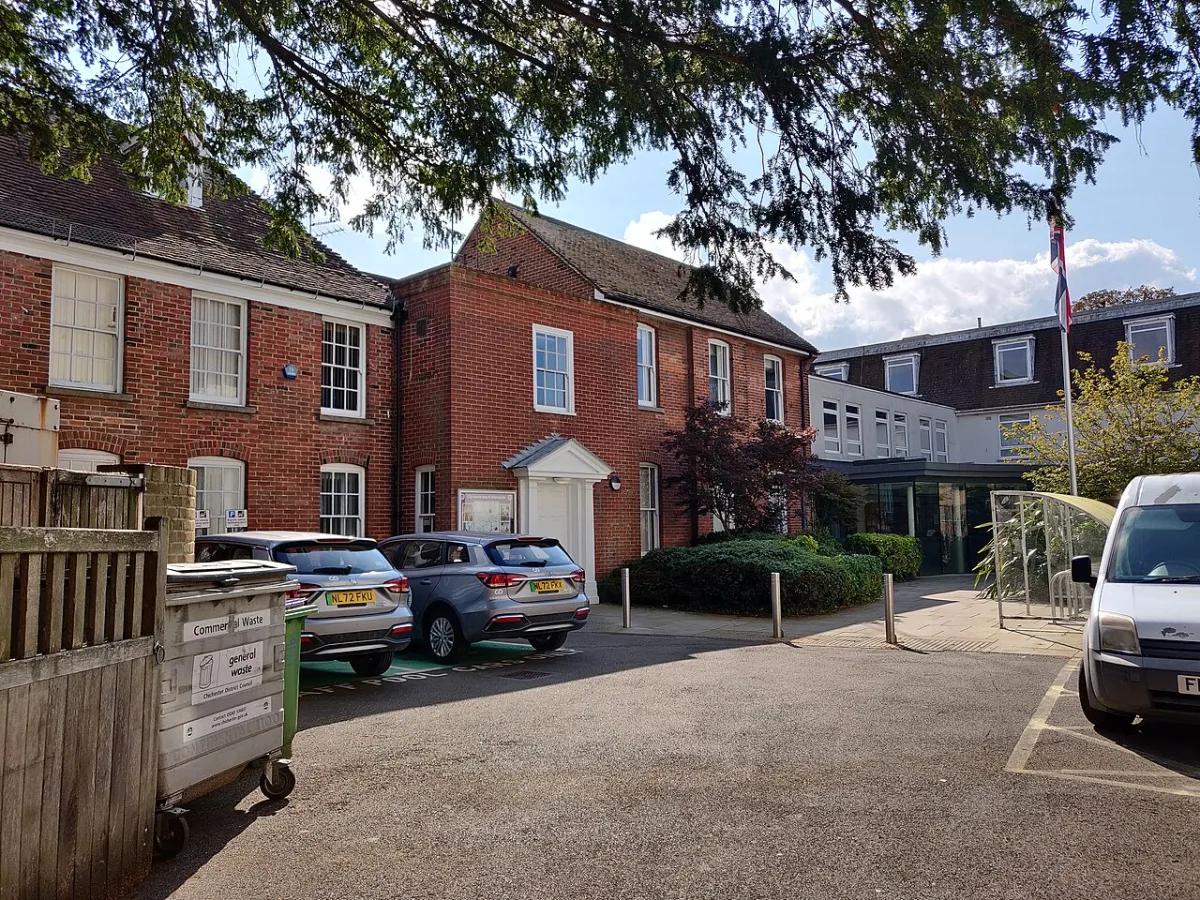

The Local Plan 2045 scoping consultation runs to 5pm on 25 September 2026, a year after the current plan was adopted. What 638 homes a year means locally.
Chichester District Council adopted its Local Plan on 19 August 2025. Ten months later it started work on the next one. The scoping consultation on the Chichester Local Plan 2045 opened on 7 August 2026 and closes at 5pm on 25 September 2026, and it is the earliest and least constrained chance anyone gets to influence what the plan covers.
This is the stage where the council asks what the plan should be about, rather than which fields should be built on. That comes later, in 2027. If you have a view on housing, the A27, water, coastal change or the gaps between villages, this is the window.
The consultation open now
The council is consulting on two documents: a Scoping Consultation asking what issues and priorities a new plan should cover, and a draft Engagement Strategy asking how residents want to be involved as it develops. A Baseline Evidence Paper sits alongside them for information, with no comment points.
- Runs: 7 August to 25 September 2026, seven weeks.
- Deadline: 5pm on 25 September 2026.
- How: through the council’s planning policy consultation portal, by representation form to the Planning Policy Team, or by post to East Pallant House, 1 East Pallant, Chichester, PO19 1TY.
- Paper copies: at the council offices and at Chichester, Selsey, Petworth, Midhurst and Southbourne libraries, and the South Downs Centre in Midhurst.
One thing to be clear about before you write anything: the Local Plan 2045 will cover only the parts of the district outside the South Downs National Park. If you live in Midhurst, Petworth, Fernhurst or the northern parishes, your planning authority is the South Downs National Park Authority, not the district council, and this plan will not set your policies.
The timetable, and the deadline nobody talks about
The council published a formal notice of commencement on 12 June 2026 and a timetable with it. These are the milestones.
The detail worth flagging is the one the council itself flags. Its timetable notes that dates beyond 1 April 2028 are subject to change, because Chichester District Council will be incorporated into a new unitary authority after vesting day.
That note is now out of date, and the council has not changed it. On 7 September 2026 the government paused the West Sussex reorganisation for a review with no end date, so there is no agreed vesting day and no agreed unitary authority. It also confirmed that the May 2027 district council elections will go ahead on existing ward boundaries. We set out what was paused, and what it means, in Chichester council merger paused, May 2027 elections on. Updated 13 September 2026.
The plan that is already in force
Until the 2045 plan lands, the Chichester Local Plan 2021 to 2039 is what planning applications are judged against. It was adopted at a Full Council meeting on 19 August 2025, after an examination that began when the council submitted the plan in May 2024.
The headline numbers:
- The local housing need for the plan area is 638 dwellings a year, giving a minimum of 11,484 homes between 2021/22 and 2038/39.
- The requirement is stepped: 575 homes a year to 2029/30, then 701 a year from 2030/31.
- 2,326 homes were completed between 1 April 2021 and 31 March 2024, with 5,257 commitments as at 31 January 2025, leaving a residual of 3,901 to be found.
- At least 7,500 homes are expected to come from strategic sites.
The stepped requirement is the compromise the council lost, and then partly won back. Cllr Bill Brisbane, the Cabinet Member for Planning, put it plainly: the plan the council submitted “proposed a housing requirement of around 90% of the government’s housing needs figure for this area. However, based on the evidence, which included representations from National Highways in relation to the A27, the Inspectors concluded that there wasn’t sufficient justification to set a housing requirement lower than the full identified housing need.”
In other words, the A27’s capacity was argued and rejected as a reason to build fewer homes. What the Inspectors did allow was the slower start. The state of the A27 and what is funded is covered separately; the short version is that the major Chichester upgrade was cancelled in 2017 and nothing has replaced it.
Brisbane also noted where the Inspectors wanted the growth: “The Inspectors agreed that the most suitable location for housing growth is Chichester and the east/west corridor, which is where the majority of the proposed new housing and strategic sites are located within the Local Plan.”
Where the homes are allocated
These are the strategic locations and allocations in Policy H2 of the adopted plan.
| Location | Homes | Status |
|---|---|---|
| Land West of Chichester | 1,600 | Carried forward from the 2015 plan |
| Land West of Tangmere | 1,300 | Carried forward from the 2015 plan |
| Southbourne broad location | 1,050 | Site to be fixed by a separate document |
| Land East of Chichester | 680 | New allocation |
| Land at Shopwyke, Oving | 585 | Carried forward from the 2015 plan |
| Westhampnett / north east Chichester | 500 | Carried forward from the 2015 plan |
| Nutbourne and Hambrook | 300 | Sites via neighbourhood plan or a later document |
| Chichester city | 270 | Sites via a later development plan document |
| Land at Maudlin Farm, Westhampnett | 265 | New allocation |
| Highgrove Farm, Bosham | 245 | New allocation |
| Loxwood | 220 | Sites via neighbourhood plan or a later document |
| Southern Gateway, Chichester | 180 | New allocation, brownfield regeneration |
Seven parishes carry a non-strategic requirement on top of that, to be met through neighbourhood plans or a later document: Wisborough Green 75, Boxgrove 50, Kirdford 50, North Mundham 50, Fishbourne 30, Westbourne 30 and Plaistow and Ifold 25, a total of 310. North Mundham had already permitted 105 homes as at 31 January 2025, so its net requirement is zero.
If a site near you is in that table, that does not mean a development is approved. It means the principle of building there has been accepted in policy, which makes a later detailed application much harder to refuse. The plan stage is where to engage if you have a view, not the week an application appears.
Southbourne: the biggest live decision
The 1,050 homes at Southbourne are the one strategic allocation where the site has not yet been chosen. The Southbourne Allocation Development Plan Document is the separate document that will fix it, and it has just cleared its final public stage: the Regulation 19 consultation ran from 5 June to 17 July 2026, asking whether the draft is legally compliant and sound.
Those representations are now being processed and will be sent, unchanged, to an independent Planning Inspector appointed by the Secretary of State, along with the plan itself. The council has not yet published a submission date. Because it started under the old system, the Southbourne DPD will be examined against the September 2023 version of the National Planning Policy Framework, not the current one.
For Southbourne, Nutbourne and Hambrook residents, this is the document that matters far more than the 2045 scoping consultation.
The constraints that shape everything here
Chichester is unusually constrained for a district of its size, and the same three issues recur in every plan document.
- Water neutrality. The adopted plan carries a dedicated water neutrality policy, NE18, on top of separate policies on water management and water quality. Development in much of the district has to demonstrate it will not increase water consumption overall.
- Nutrient neutrality in Chichester Harbour. Policy NE20 requires development draining to the harbour to be nutrient neutral. The harbour is also an Area of Outstanding Natural Beauty with its own policy, NE14.
- The A27. National Highways’ evidence on the road was central to the examination, and the plan directs growth to the corridor either side of the city.
Cllr Brisbane described the plan as “one of the most complex pieces of work we have ever undertaken”, citing “roads, wastewater, and water neutrality” as the reasons. He also acknowledged the brownfield problem: “our area lacks a legacy of large industrial sites that are suitable for significant levels of brownfield redevelopment”, with the Southern Gateway named as the exception.
How to follow individual applications
The Local Plan sets the rules; individual applications are decided against them week by week. Chichester District Council publishes every one on its Public Access portal, where you can search by road, view documents and comment during the consultation period. Applications in the northern part of the district go to the South Downs National Park Authority instead.
- Chichester District Council Public Access portal
- Planning policy updates, the council’s running log of what is out for consultation
Sources
- Chichester Local Plan 2045 scoping consultation for the consultation dates, how to respond and where to view documents.
- New Local Plan timetable for the milestone dates and the note on the new unitary authority.
- Notice of intention to commence local plan preparation, given 12 June 2026.
- Chichester Local Plan 2021-2039, Chapter 5: Housing for the 638 dwellings a year figure, the stepped requirement, the supply position and the Policy H2 and H3 allocation tables.
- Chichester Local Plan 2021 - 2039 (adopted) for the adopted plan and adoption date.
- Southbourne Allocation Development Plan Document for the Regulation 19 consultation dates and next steps.
- Chichester District Council’s adoption announcement, carried in full by Southbourne Parish Council, for the Cllr Bill Brisbane quotes.
- Planning policy updates for the dated log of consultations.
Checked on 9 August 2026. We will update this page when the Southbourne DPD is submitted for examination and when the scoping consultation closes on 25 September.
More Chichester local information: house prices, trains to London, roadworks and travel and things to do in Chichester.
Have your say