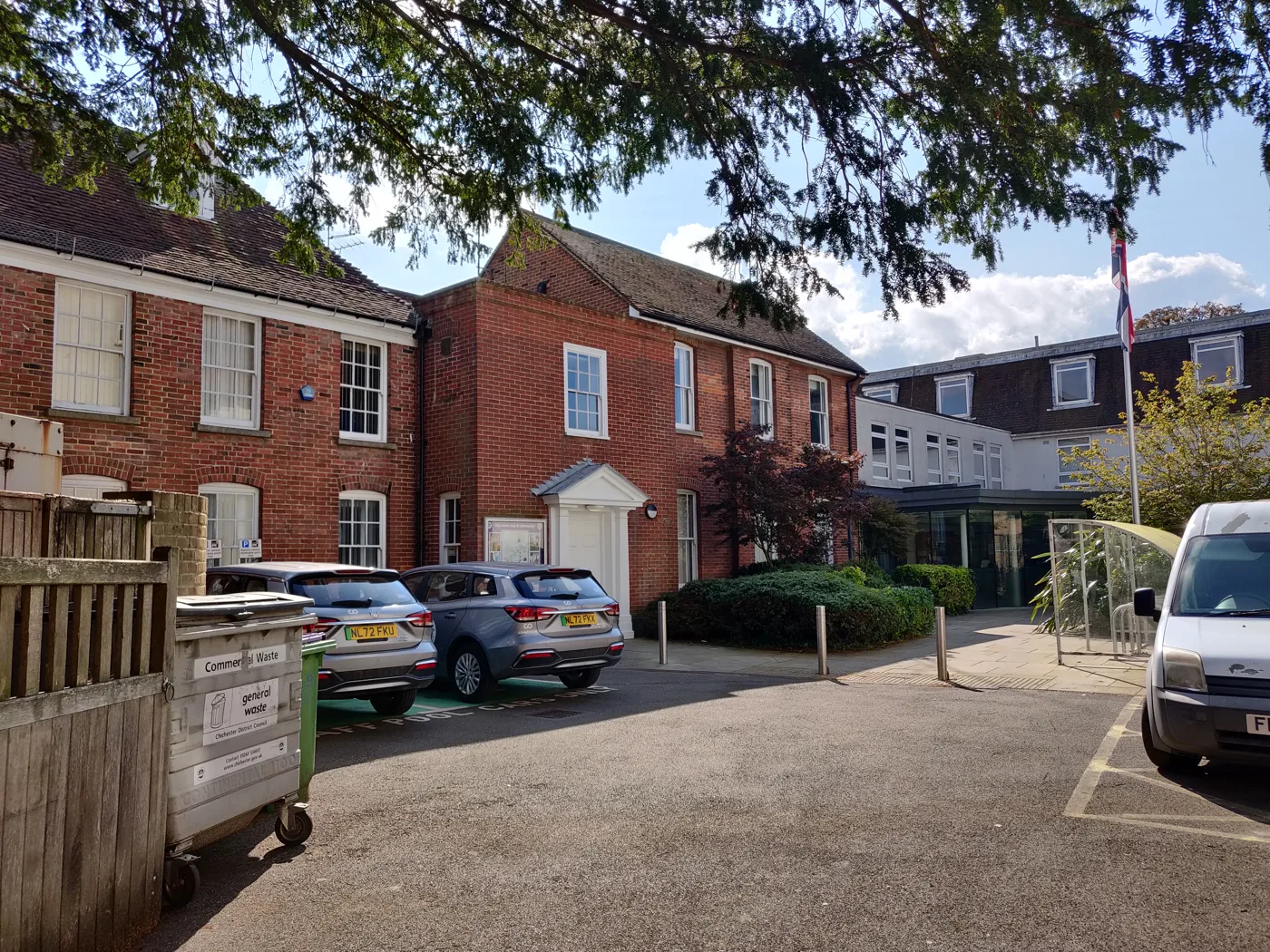

West Sussex is one of two areas still waiting for a ruling. New councils now start in 2029, after shadow elections in 2028; district elections stay in May 2027.
The government has still not decided what happens to Chichester District Council. West Sussex was left waiting again on Thursday, while five other areas were told their mergers can go ahead.
The Ministry of Housing, Communities and Local Government announced the next steps in its review of local government reorganisation at lunchtime on 29 October. It is “minded to” go ahead in five areas, subject to at least three weeks of further representations:
- East Sussex and Brighton and Hove (two unitary councils)
- Gloucestershire (one)
- Oxfordshire (three)
- Warwickshire (two)
- Worcestershire (two)
West Sussex is not on that list. It is one of only two areas, with Cambridgeshire and Peterborough, that the government lists as “awaiting decisions”. The announcement says every remaining area “will have an outcome by early next year”.
The new timetable
The announcement also moves the finishing line. New councils will be set up for 2029, with elections to shadow councils in May 2028. Local elections in the areas still under review go ahead in May 2027 on existing boundaries.
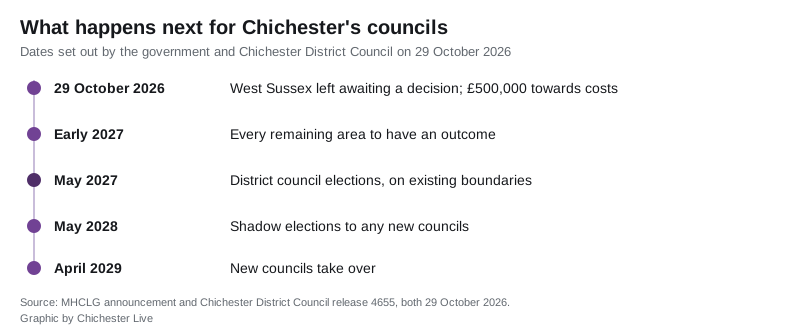
Chichester District Council’s own statement, issued the same afternoon, says a final decision for West Sussex “is unlikely to be made until early in the new year”. It adds that the government has said some areas may hear before Christmas. The council gives April 2029 as the date new authorities are expected to come into effect.
West Sussex will also get £500,000 from the government’s £63 million capacity fund, to cover costs already incurred. The announcement says that is paid “as decisions have yet to be made there”, with the balance after a final decision.
What is still on the table
Nothing has been ruled out. In September we set out the two competing maps:
- The councils’ plan, backed by every district and borough in the county, put Chichester in a coastal unitary with Arun, Worthing and Adur.
- The government’s modified version, consulted on in May and June, put Chichester with Crawley, Horsham and Mid Sussex instead.
The council says the government “has confirmed that all options for West Sussex remain under consideration”. Neither map has been chosen.
What the council says
Councillor Adrian Moss, Leader of Chichester District Council, said:
“While it is frustrating that a decision on local government reorganisation in West Sussex has been delayed, we welcome the additional time to ensure that any future arrangements are carefully considered and deliver the best possible outcomes for our residents, communities and businesses.”
He pointed to one thing that has become clearer. East Sussex and Brighton and Hove are now going ahead on their own, so “any future proposals affecting our area will be focused within the West Sussex boundary”. He said it “remains very much business as usual”.
That is a softer tone than in September, when the same leader called the lack of certainty “unacceptable”.
What it means for you
- You still vote for Chichester District Council in May 2027, in your current ward. Both the government and the council confirm it.
- Any new council’s first election would be in May 2028, a year later. It would take over in April 2029.
- Your services do not change. Bins, planning and council tax stay with the district and county councils until a new council takes over.
- The date to watch is early 2027, when the government says West Sussex will have its answer.
The council publishes updates on its Devolution and Local Government Reorganisation page.
Sources
- Local Government Reorganisation moves forward in five counties, Ministry of Housing, Communities and Local Government, 29 October 2026.
- Government delays decision on local government reorganisation in West Sussex, Chichester District Council, 29 October 2026, reference 4655.
Have your say