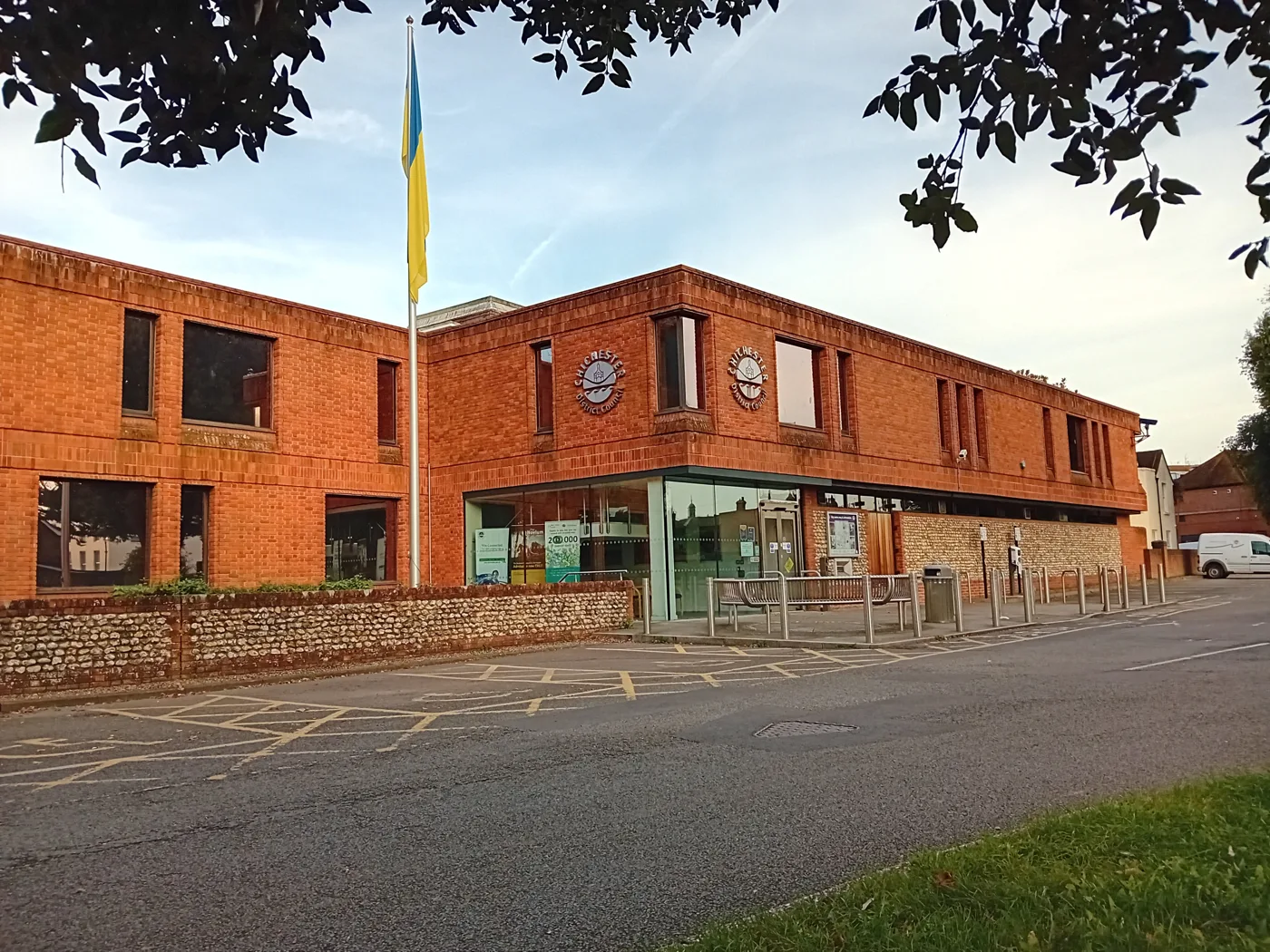

Chichester must plan for about 991 homes a year, against 638 when its plan was adopted, and says a new settlement is now on the table. Views close 5pm Friday.
The public consultation on Chichester’s next Local Plan closes at 5pm on Friday 25 September, and the number buried on page 24 of it is 991.
That is roughly how many homes a year the council now has to plan for in the Chichester plan area, the district outside the South Downs National Park. When the current Local Plan was adopted in August 2025, the assessed need was 638 a year, and the plan itself committed to 575 a year until 2029/30.
The council also says, in its own words, that the existing strategy “cannot simply be ‘topped up’” to absorb that. Among the options it will now have to test are new settlements.
None of this appears in the council’s press release about the consultation. It is in the Scoping Consultation document, the 50-question PDF that residents are being asked to comment on.
The numbers, and where they come from
Paragraph 8.1 of the scoping document sets out where Chichester started. The adopted Local Plan set a stepped housing requirement:
- 575 dwellings a year from 2021/22 to 2029/30
- rising to 701 a year for the years to 2038/39
- 11,484 dwellings in total between 2021/22 and 2038/39
The assessed need at the time the plan was adopted was 638 dwellings a year.
Then the arithmetic changed. The government altered its standard method for calculating housing need in December 2024. As of May 2026, the document says, the standard method figure for the whole of Chichester District is 1,294 dwellings a year.
That district figure includes the South Downs National Park, which the council does not plan for. So a joint study was commissioned from consultants AECOM by the South Downs National Park Authority together with Chichester District, East Hampshire District, Lewes District and Winchester City councils. It applied the standard method across the National Park and the overlapping councils, then split the total according to where the existing homes are.
Chichester’s share, for the plan area outside the National Park, came out at 991 a year.
Why a plan adopted last year is being replaced
The council did not choose this. Paragraph 1.8 of the scoping document gives the trigger. The council was required to undertake an immediate review of its plan and formally commence work in June 2026. The reason it gives is that “the adopted local plan housing requirement is less than 80 per cent of the latest government assessment of housing need for the Chichester plan area”.
The council’s own frequently asked questions put it more bluntly. Chichester is one of 39 councils across England that must begin a new local plan because of planning reforms that came into force in March 2026. That is, in the council’s words, “despite having only adopted its current local plan in August 2025”.
There is a second pressure behind it. The council’s housing land supply page shows a five-year supply of 5.16 years as at 1 April 2025. A 1 July 2026 update then applied the 20% buffer now required by paragraph 78(c) of the National Planning Policy Framework, and that brings the same supply data down to 4.52 years. The council calls that an interim position and says the 2026 to 2031 figure will be confirmed in due course.
The scoping document explains what being below five years means, at paragraph 2.5: if a council “cannot demonstrate a deliverable five-year supply of housing land, national planning policy applies more strongly in decision-making. This can reduce the council’s ability to refuse planning applications that do not align with local priorities.”
What the council says it will have to consider
Paragraph 8.13 is the passage most likely to matter to people living in the villages. The council writes that the new figure “will require a review of the current spatial strategy as the current dispersed/east-west corridor strategy cannot simply be ‘topped up’ to meet the new housing target”.
It lists what the plan will now need to test:
- new settlements
- significant extensions to existing places
- intensified sustainable locations
- optimal densities, to use land more efficiently
- brownfield land
- growth around rail stations, and new or enhanced public transport links
The same section is candid about the obstacles. Paragraph 8.18 lists what “will all shape where growth can realistically go”:
- water supply
- wastewater capacity
- the A27 and the wider transport network
- the lack of an up-to-date transport model
- health and education infrastructure
- grid capacity
Two of those are singled out later in the document. Paragraph 12.9 calls water and wastewater capacity “likely to be one of the most significant constraints on the level of and location of growth”. Paragraph 12.10 says the A27 and the wider network “may limit growth, particularly around Chichester and the A259 east-west corridor”.
For context on how much has already been built: since the start of the plan period a net total of 2,902 dwellings have been completed, including 885 affordable homes.
What it means for you
This consultation is not about sites. The council states plainly that it is not consulting on where development will go at this stage. It is asking what people value, what the challenges are, and what should be prioritised. Site allocations come at the next stages, in 2027 and 2028.
The deadline is 5pm on Friday 25 September 2026. There are four ways to respond:
- On the council’s consultation portal, which is where the documents and the comment boxes sit.
- By completing the representation form and emailing it to the planning policy team.
- By posting a form to Planning Policy Team, Chichester District Council, East Pallant House, 1 East Pallant, Chichester, PO19 1TY.
- In person, where paper reference copies are available: the council offices at East Pallant House, 9am to 4pm Monday to Friday; Chichester, Selsey, Petworth, Midhurst and Southbourne libraries; and the South Downs Centre in Midhurst.
If you live inside the South Downs National Park, this is not your plan. The National Park Authority prepares planning policy for its own area. The Chichester Local Plan 2045 covers the parts of the district outside it.
One quirk worth knowing before you write. The scoping document was written against the draft National Planning Policy Framework of December 2025, and refers to it 35 times. The final NPPF was published on 17 August 2026, ten days after this consultation opened. The council flags this itself at paragraph 2.8 and asks respondents to refer to the draft “or the final updated NPPF should it become available during the consultation period”. It will carry out a detailed review of adopted policies once the framework is settled.
The plan will be adopted by a council that does not yet exist
The council’s published Local Plan timetable runs to adoption by 30 April 2029. The milestones are:
| Stage | Dates |
|---|---|
| Scoping consultation | 7 August to 25 September 2026 |
| Gateway 1 self-assessment published | by 31 October 2026 |
| Consultation on plan content and evidence | 4 June to 16 July 2027 |
| Gateway 2 advice sought | by 30 September 2027 |
| Consultation on the proposed plan | 28 January to 31 March 2028 |
| Gateway 3 advice sought | by 30 September 2028 |
| Submission for examination | by 31 October 2028 |
| Adoption | by 30 April 2029 |
The timetable carries a caveat that is easy to miss: “The dates beyond 1 April 2028 will be subject to change as Chichester District Council will be incorporated into a new unitary authority after vesting day.”
In other words, on the published programme, every stage from the proposed-plan consultation onwards would be handled by a new council. That assumption is now less certain than it was when the timetable was written. On 8 September the government paused local government reorganisation in West Sussex while it reviews the programme, with no timetable given for when the review will conclude.
The council is also honest about the pace. Paragraph 1.10 notes that the 30-month timescale the timetable is built on is “the government’s aspiration”, and that preparing the plan “may end up taking closer to 3 or possibly even 4 years”.
Sources
- Chichester District Council, Scoping Consultation and Draft Engagement Strategy, read 20 September 2026
- Chichester District Council, Local Plan 2045 Scoping Consultation (PDF)
- Chichester District Council, New Local Plan timetable
- Chichester District Council, Housing land supply
- Chichester District Council, Residents and businesses reminded to share their views in local plan consultation, 11 September 2026
More Chichester information: planning news, house prices and roadworks and travel.
Have your say